Two players, same slot, opposite approaches — which one survives longer?
Player A spins at £5.00 a go, chasing the free spins round that'll pay for the session. Player B sets a £0.50 stake, watches the balance, stops after 100 spins regardless. Same slot, same RTP, but one plan lasts three minutes and the other stretches to half an hour. The difference isn't luck — it's the only variable you actually control.
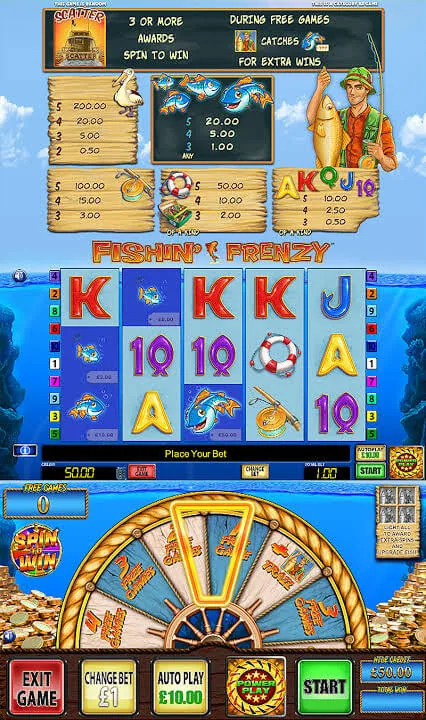
Fishin Frenzy is a 5×3, 10-line slot from Reel Time Gaming with 96.12% RTP and medium volatility. The mechanic is simple: land three Boat scatters to trigger 10 free spins, during which the Fisherman wild collects every fish prize on screen. Base game pays are modest; the bonus round carries the weight. That structure creates a rhythm — long waits punctuated by occasional surges — and it's that rhythm players misread as a pattern they can exploit.
The myth of hot and cold streaks
Walk through any forum and you'll see the same advice: if the slot hasn't triggered in 50 spins, it's «due». If it paid twice in 20 spins, walk away before it «goes cold». Both claims rest on the gambler's fallacy — the belief that independent events influence one another.
Fishin Frenzy uses a certified random number generator audited under UKGC requirements. Every spin is independent. The slot doesn't remember your last 50 rounds, doesn't track how long since the bonus hit, and doesn't compensate for a recent win by withholding the next trigger. The 96.12% RTP is a long-term average calculated over millions of spins, not a promise that your £100 deposit will return £96.12 by the end of the evening.
Medium volatility means you'll see regular small wins and occasional dry spells, but the bonus frequency is governed by scatter probability on each reel, not by time elapsed or spins completed. Chasing a «due» feature is the fastest route to an empty balance.
What the interface actually lets you control
Strip away the superstition and three levers remain: stake per spin, session length, and the moment you stop. That's the strategy — not pattern-spotting or timing, but resource management.
- Stake: UKGC operators enforce a £5.00 cap per spin for all players, and a £2.00 cap for anyone aged 18 to 24. Lower stakes extend your session; higher stakes amplify volatility and shorten your runway before the balance hits zero.
- Session clock: decide in advance how many spins you'll play or how long you'll sit. Medium volatility doesn't guarantee you'll hit the bonus in 100 spins, but it does mean you're less likely to burn through your deposit in ten minutes than you would on a high-variance slot.
- Stop point: set a win target and a loss limit before you start. The slot doesn't care whether you've won or lost; the urge to chase losses or protect winnings is entirely on your side of the screen.
Every UKGC-licensed site offers deposit limits, session reminders and reality checks. Use them. Affordability checks now start from £150 net deposits a month, and operators pull credit-reference data at the first stage. The regulator isn't asking out of curiosity — it's a friction point designed to make you pause.
Reading the volatility: what medium actually means
Volatility describes the shape of your balance curve, not the odds of winning. A low-volatility slot pays small amounts frequently; a high-volatility slot delivers rare but substantial hits. Fishin Frenzy sits in the middle: frequent enough base-game wins to keep the balance ticking over, but the bulk of the return comes from bonus rounds that may take 80, 120 or 200 spins to land.
In practice, medium volatility feels like this: you'll see stretches where the balance drifts down by 20% or 30% without a feature trigger, then a single bonus round that recovers most of the loss — or occasionally doubles your starting stake. The danger is mistaking a downward drift for a «cold» phase and increasing your stake to force a result. The slot doesn't respond to pressure. It just processes the next RNG outcome.
If you're staking £1.00 per spin with a £50 deposit, you have 50 base spins before you're out — unless wins extend that. A single bonus at spin 40 might push you back to £60 or £70, giving you another 20 spins. Or it might return £15 and you're still sliding. That's volatility: the outcome range is wide, and your bankroll needs enough depth to survive the low end.
Costly mistakes players make without noticing
The interface is clean and the mechanic is simple, which makes it easy to miss the decisions that quietly drain your balance faster than the RTP predicts.
- Chasing losses with higher stakes. You've dropped £30 in 40 spins at £0.50, so you bump it to £2.00 to recover faster. Now you're burning through £2.00 every few seconds, and one bad run of 15 spins costs another £30. The slot doesn't pay you back for previous losses; it just processes the new stake at the same RTP.
- Ignoring the session clock. Medium volatility creates a rhythm that feels sustainable — a win here, a small loss there — and an hour disappears without a conscious stop point. Set a timer or a spin count before you start, and honour it when it arrives.
- Playing through a bonus win to «see if it triggers again». You hit a £120 free spins round on a £40 deposit and you're up £120. The temptation is to keep spinning because the slot «just paid». It hasn't changed state. The next 50 spins are statistically identical to the 50 before the bonus, and most players give back a large portion of the win before they notice.
- Misreading demo mode. Free play is common on UKGC sites, but you'll need to log in and verify your age to access it on many operators. Demo mode runs the same RTP and RNG as real-money play, but the psychological weight is absent. A strategy that feels sustainable in demo can collapse under the pressure of real stakes.
How to structure a session with a fixed limit
A session plan isn't a strategy to beat the slot; it's a framework to control the variables you own. Start with your deposit, decide your stake, and calculate how many spins you can afford before the balance reaches a point you've agreed not to cross.
| Deposit | Stake per spin | Base spins | Expected triggers | Likely outcome | |
|---|---|---|---|---|---|
| £20 | £0.20 | 100 | 0–1 | Moderate chance of a bonus; balance likely down 20–40% if none land | → |
| £50 | £0.50 | 100 | 0–1 | One feature may recover losses or push into profit; two features likely profitable | → |
| £100 | £1.00 | 100 | 0–1 | Deeper buffer for volatility; 2–3 bonuses needed to finish ahead | → |
| £50 | £2.00 | 25 | 0 | High risk of zero balance before a feature; not recommended for medium volatility | → |
The table assumes no base-game wins, which is pessimistic — you'll land small pays throughout — but it shows the structural risk. At £2.00 per spin with a £50 deposit, you're giving the slot 25 chances to trigger a feature that statistically appears once every 100–150 spins. The maths doesn't favour you.
Better approach: stake low enough to survive 100–150 spins, giving yourself a realistic shot at one or two bonus rounds. If the first feature pays well, bank half and play the rest. If you hit your loss limit — say, 50% of your deposit — stop. The slot will still be there tomorrow, and your balance won't.
Where UKGC rules shape your session
The regulatory environment in the United Kingdom isn't background noise — it directly affects how you play and what the operator can offer.
- Stake caps: £5.00 maximum per spin for all players, £2.00 for anyone aged 18–24. If you're in the younger bracket, your effective volatility is lower because your maximum exposure per spin is capped.
- Affordability checks: deposit £150 or more in a month and the operator may ask for proof of income or run a credit check. This isn't optional; it's a licence condition. If you can't or won't provide the information, your account may be restricted.
- KYC before withdrawal: age and identity checks happen before your first deposit on most sites, but documents are required before your first withdrawal. Expect 24–48 hours for verification, longer if the operator queries a document.
- GAMSTOP: one registration blocks every UKGC-licensed site for six months to five years. If you've self-excluded, there's no workaround — and unlicensed sites operating in the UK are illegal to use.
Withdrawal speed depends on method. E-wallets clear in a few hours to 24 hours; Faster Payments to your bank take the same day to two working days; debit card withdrawals take one to three working days. Every UKGC operator holds a remote gambling licence, and the licence number sits in the footer. Look it up in the UKGC public register and match the number before you deposit.
The honest conclusion: no strategy beats the RNG
Fishin Frenzy doesn't have a weak point you can exploit, a pattern you can decode, or a moment when it's «due» to pay. The RTP is fixed, the RNG is certified, and every spin is independent. What you can control is stake size, session length, and the discipline to stop when your plan says stop.
Medium volatility offers a reasonable balance: frequent enough small wins to make the session feel interactive, occasional bonus rounds that deliver meaningful returns, and a pace that doesn't burn through your deposit in ten minutes. But «reasonable» doesn't mean «safe». You can still lose your entire deposit in a single session, and most players do more often than they'd like to admit.
The interface gives you three tools: the stake selector, the spin button, and the cashier. Use the first to control your exposure, the second to play within your limit, and the third to withdraw when you're ahead. That's the strategy. Everything else is noise.
FAQ
Can I improve my odds by changing my stake mid-session?
No. The RTP and RNG are constant regardless of stake size. Increasing your bet doesn't make the bonus trigger sooner; it just means you lose your deposit faster if the feature doesn't land. Lower stakes extend your session and give you more chances to hit a bonus round, but they don't change the probability of any individual spin.
Is there a best time to play Fishin Frenzy for better results?
No. The slot doesn't track time of day, player volume, or recent payouts. Every spin is governed by a certified RNG, and the outcome is independent of when you play or how many other players are online. «Hot» and «cold» periods are retrospective patterns, not predictive signals.
How many spins should I budget for before expecting a bonus round?
Medium volatility and scatter probability suggest the free spins feature triggers roughly once every 100–150 spins, but that's an average over millions of rounds. You might hit two bonuses in 50 spins or go 250 spins without one. Budget enough spins to survive the lower end of variance — at least 100 at your chosen stake — or accept that you may not see a feature in your session.
What happens if I hit the £250,000 max win cap?
The game round ends immediately and your balance is capped at £250,000, which is 10,000× your total bet. Any further fish prizes collected during that spin or free spins sequence are void once the cap is reached. In practice, hitting this ceiling requires a near-perfect bonus round at the maximum stake, and it's exceptionally rare.